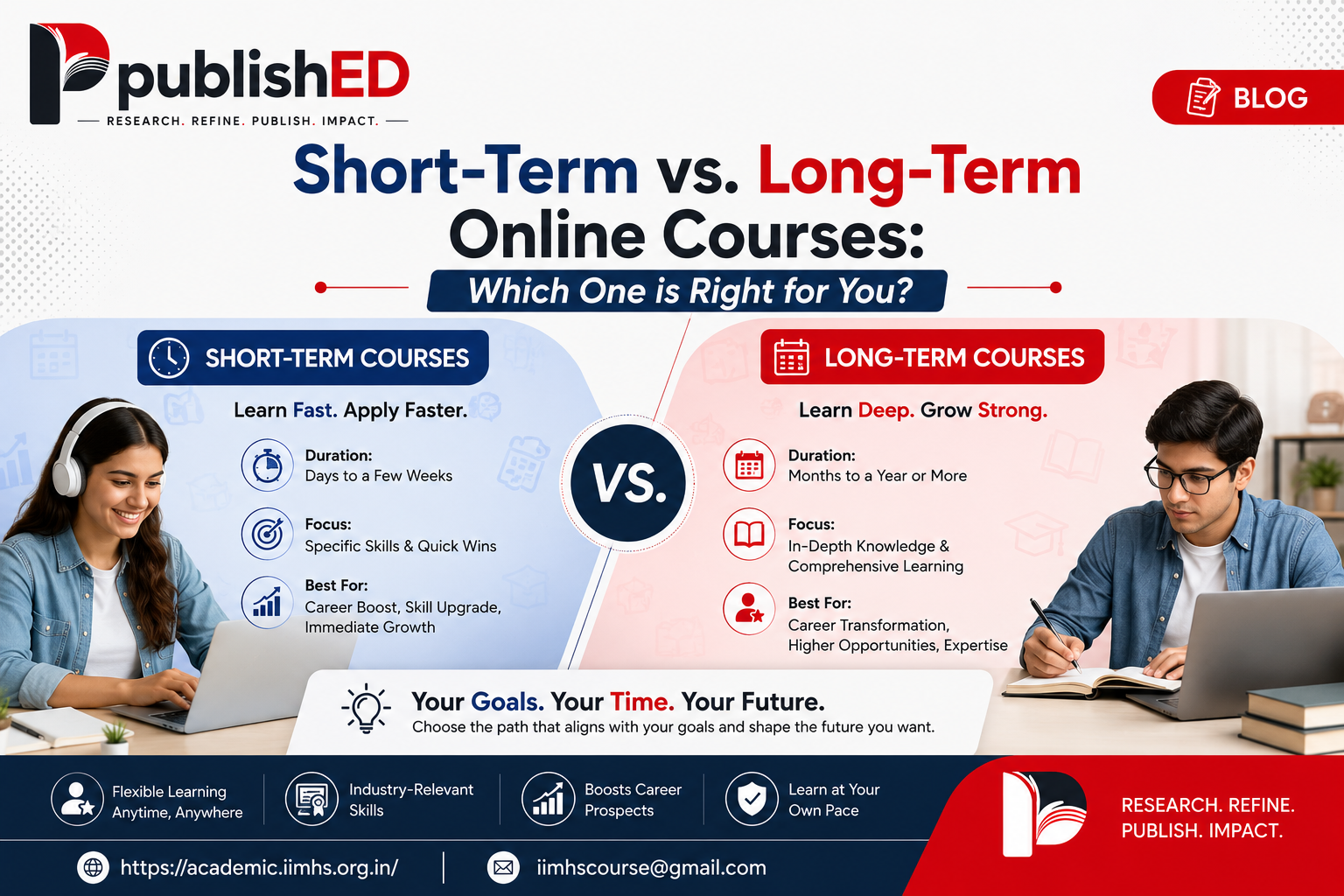
Short-Term vs. Long-Term Online Courses: Which One is Right for You?
The online education landscape offers unprecedented choices for career growth. Whether you are looking to quickly master a specific tool or completely transition into a new industry, modern e-learning platforms provide options tailored to every schedule, budget, and professional goal.
However, one of the first and most critical decisions every learner faces when browsing a course catalog is choosing the right program duration: Should you enroll in a targeted Short-Term Certificate Course or commit to a comprehensive Long-Term Diploma or Degree Program?
Making the wrong choice can lead to wasted time, unnecessary financial strain, or a credential that doesn't align with your career goals. This guide breaks down the core differences, advantages, career impacts, and decision frameworks to help you choose the right path for your journey.
1. Defining the Two Learning Paths
Understanding the structural differences between short-term and long-term learning models is the first step toward making an informed choice.
Short-Term Certificate Courses
-
Duration: Typically 2 weeks to 3 months (10 to 50 learning hours).
-
Core Purpose: Designed for rapid skill acquisition, bridge training, software mastery, or specialized industry updates (e.g., a clinical workshop certification like Dentocon, a focused UI/UX design sprint, or a digital marketing masterclass).
-
Target Outcome: Immediate application to a current job role or adding an instant, verifiable badge to your resume.
Long-Term Diploma & Degree Programs
-
Duration: Ranges from 6 months to 2 years (150+ learning hours).
-
Core Purpose: Provides end-to-end foundational knowledge, covering both theoretical principles and extensive practical applications (e.g., a Diploma in Full-Stack Web Development, Healthcare Administration, or Data Science).
-
Target Outcome: Facilitating major career shifts, qualifying for regulated industry entry, or building deep academic expertise.
2. Head-to-Head Comparison

3. When to Choose a Short-Term Course
Short-term courses are built for speed, agility, and precision. They are ideal if you need immediate results without interrupting your daily schedule
Key Advantages:
-
Low Friction & High Completion Rates: Because these programs require fewer total hours, students are significantly more likely to finish them alongside full-time jobs.
-
Immediate On-the-Job Application: What you learn on Tuesday evening can often be applied directly to your workplace project on Wednesday morning.
-
Cost-Effective Experimentation: If you are curious about a new field (e.g., testing whether you enjoy web design or health data management), a short-term course lets you explore without a huge financial commitment.
Best Suited For:
-
Working Professionals: Looking to learn a single tool or framework (e.g., mastering Laravel Blade, SEO analytics, or a specific medical protocol).
-
Students & Graduates: Wanting to stack extra, verified certificates on top of an existing university degree.
-
Continuous Learners: Attending specialized clinical workshops, webinars, or annual conferences to earn continuing education units.
SEARCH
OUR ACHIEVEMENTS










PARTNERS